How it works
One night, start to finish.
The nightly run
The timeline.
0103:30
Incremental pull
New and changed orders, customers and products since the last high-water mark, minus a 2 hour safety buffer. The nightly incremental covers the cycle in about 1 minute 48 seconds. Bad data is refused: if a field the subscription logic depends on is under 5 percent populated, the run stops rather than corrupt the history.
02models
Five models retrained from scratch
Four decide who will buy: reorder, subscription, cross-sell and resubscribe. The fifth decides what to offer. All five are retrained every night rather than scored from a stale file, and the four customer models are each graded walk-forward on customers they have never seen. On 21 Sep 2026 the three customer models then running finished at 01:30:43, 01:34:00 and 01:37:47 UTC.
03scoring
Every customer scored
All 568,836 customers on the first brand, with calibrated probabilities that are comparable across campaigns.
04assign
One campaign per customer
Exactly one of 14 lifecycle states. Nine are campaigns: reorder, cross-sell, subscription, second order, resubscribe, paused-subscriber resume, win-back, reactivation and dormant. The rest are holds, where the right message is none. One pure function decides, and the same function is used by the nightly run and by the evaluator that grades it.
05products
Products picked
Up to 3 per customer from a ranker over 72 features per customer and product, including the full purchase history. Free samples are never offered.
06reason
The reason written
One sentence per prediction, built only from the signals that drove it. Reorder confidence is a lift multiple, never a raw percentage. A buying rhythm is quoted only when it is plausible.
07eligibility
Eligibility computed
Who may be contacted tomorrow: not inside the 21 day cooldown, not someone who just bought, not anyone Klaviyo cannot deliver to. Send eligibility was ready by 01:54 UTC on 21 Sep 2026.
08swap
Database rebuilt beside the live one, then swapped
The build never touches the live database. It rebuilds against a snapshot copy and swaps atomically; the full rebuild was done by 01:48 UTC on 21 Sep 2026. The API serves the old data the whole time.
09health
Health poll
The service is checked for up to 60 seconds after the swap. If it fails, the previous database goes back automatically and one retry follows 10 minutes later.
1009:00 to 18:40
Sends, in 20-minute slices
A timer fires every 20 minutes from 09:00 to 18:40 local time. Each fire sends what is left divided by the fires still to come, so a late or missed fire corrects itself.
Local step timings from one full run, for scale: recommend 115 s, reorder model 52 s, cross-sell model 85 s, campaigns 135 s, profiles 94 s.
The handoff
What Klaviyo receives.
{
  "metric": "Reorder prediction by Unlapse",
  "email": "lena@example.com",
  "profile_properties": {
    "unlapse_lifecycle_stage": "repeat_buyer",
    "unlapse_top_product": "House Blend 500 g",
    "unlapse_order_cadence_days": 31,
    "unlapse_next_predicted_order": "2026-09-24",
    "unlapse_emailed_at": "2026-09-23"
  },
  "properties": {
    "unlapse_prediction_type": "repeat_buyer",
    "unlapse_score": 0.31,
    "unlapse_reason": "Active buyer, 6 orders ~every 31d, 34d since last order; reorder nudge for House Blend 500 g, model ranks them ~12x likelier to reorder than average.",
    "unlapse_cart_url": "https://morrow-coffee.example/cart/41001:1,41002:1,41003:1",
    "unlapse_cart_total": 29.30,
    "unlapse_products": [
      {
        "name": "House Blend 500 g",
        "price": 14.90,
        "is_reorder_for_customer": true,
        "times_bought_by_customer": 6,
        "avg_reorder_gap_days": 31,
        "cart_url": "https://morrow-coffee.example/cart/41001:1"
      },
      { "name": "Slow Sunday Decaf 250 g", "price": 9.90, "is_reorder_for_customer": false },
      { "name": "Paper Filters, 100", "price": 4.50, "is_reorder_for_customer": true, "times_bought_by_customer": 2 }
    ]
  }
}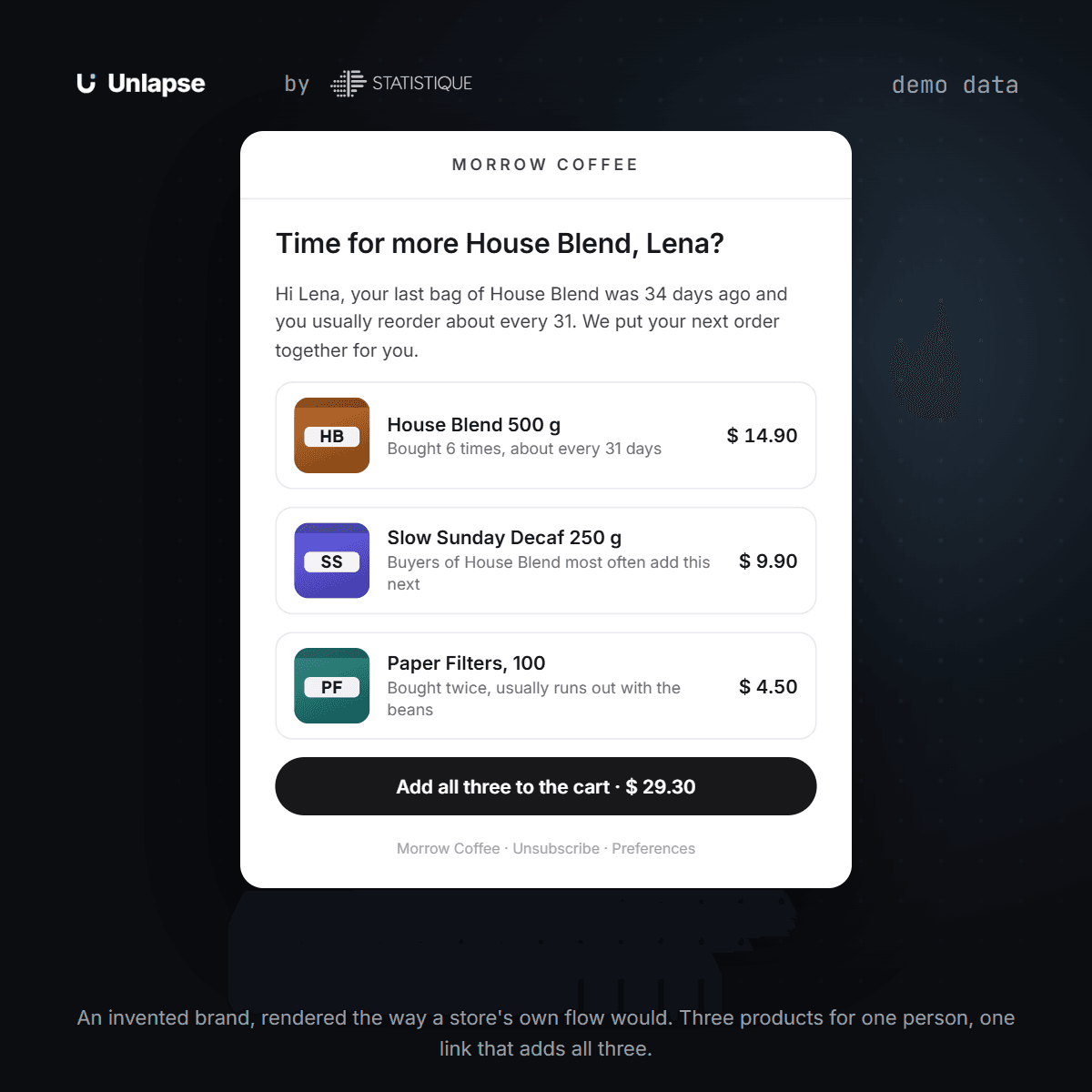
- One builder. The event your platform receives and the feed a partner can pull come from the same code, so they cannot diverge.
- A native cart link. A store permalink that adds every product at once, with no app in the path.
- Idempotent. Each event carries a hash of organisation, customer, campaign, day and product, so a same-day re-run cannot double-send.
Tell us about your store.
We read your order history first and tell you what the engine would do with it. Then you decide.